
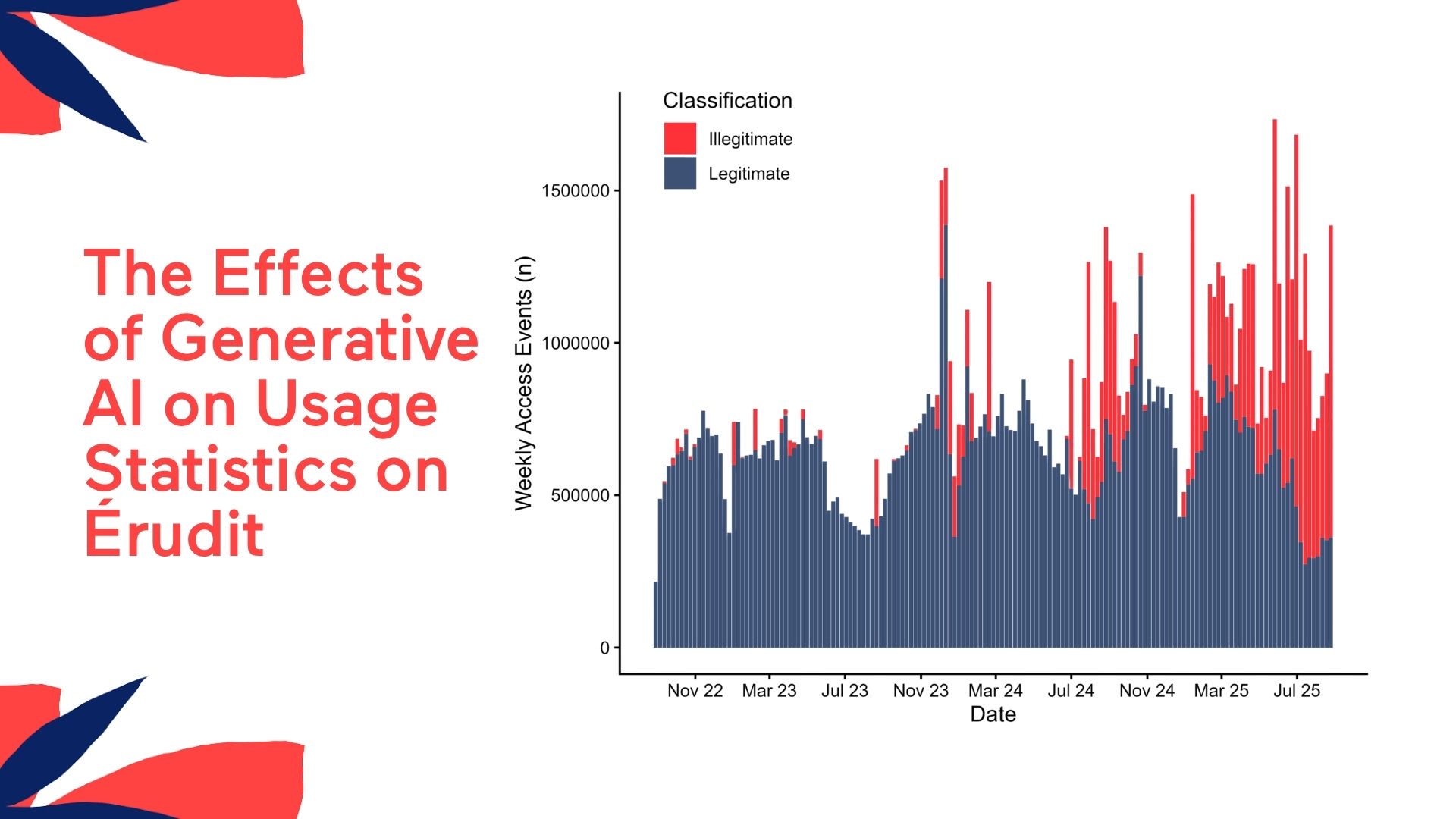
Artificial intelligence is transforming the way scientific knowledge is being shared. What effects do these new uses have on the publications disseminated on Érudit? A preliminary analysis of our data has allowed us to better understand the changes that are ongoing and what they mean for the dissemination of knowledge.
Publication written by Simon van Bellen, Senior Research Advisor, Érudit. orcid.org/0000-0002-1698-8530
The Phenomenon of Zero-Click Search
The rapid growth in the number of AI-powered applications is transforming scholarly publishing. Not only does it affect the writing and peer review processes, it also impacts how Internet users find and process information.
Several research tools now integrate generative AI functionalities capable of providing a direct synthesis of documents following a search request. These new functionalities, which promote “zero-click search”, tend to reduce usage of the original source. This very recent phenomenon has not yet been studied extensively. However, certain figures are pretty telling: the availability of Google AI Overviews can reduce the number of external clicks by close to 40%. Zero-click search has led to a notable reduction in the usage of original online content for several organizations, from Wikipedia to the Oxford University Press. Cairn, a scientific dissemination platform, reported a 26% decrease in usage for its scholarly journals between 2024 and 2025.
The other major impact of generative AI on scholarly communication is the constant pressure exerted by bots on digital infrastructure. These bots engage in large-scale scraping of web pages as to feed the large language models on which generative AI applications rely. These bots operate in a way that does not reflect normal human behaviour nor a particular interest in scholarly research, and they threaten the stability of dissemination sites, which must sometimes limit access to web users to protect their technological infrastructure. Various resources, such as the Open Science Framework (Center for Open Science), Zenodo and the Duke University Library in the United States, have recently reported issues relative to mass requests for access from bots.
Therefore, zero-click search and the increase in the number of access events generated by bots have opposite effects on the measuring and the tracking of usage. While zero-click search tends to reduce usage for the original content, massive scraping inversely tends to artificially inflate the recorded number of access events.
What We Observe on Érudit
Érudit is not immune to these trends. During the first half of 2025, our systems recorded particularly high numbers of access events which seemed, at first glance, to be legitimate. However, we came to realize that a major part of this traffic was, in reality, bots engaging in large-scale scraping of the full-text content of scholarly articles disseminated on our platform. On specific days in summer 2025, bots generated up to 80% of the access events recorded on Érudit.
The scope and the pace of this phenomenon have created substantial issues for our infrastructure. Our detection methods at the time did not allow us to identify all these automated access events, and some were categorized as legitimate (Table 1). In other words, the data from this period, compiled based on the international COUNTER standard for access to web content, overestimated usage actually attributable to human users. Érudit was not alone in dealing with this phenomenon, as the rapid multiplication of the number of scraping bots caught several infrastructure providers by surprise.
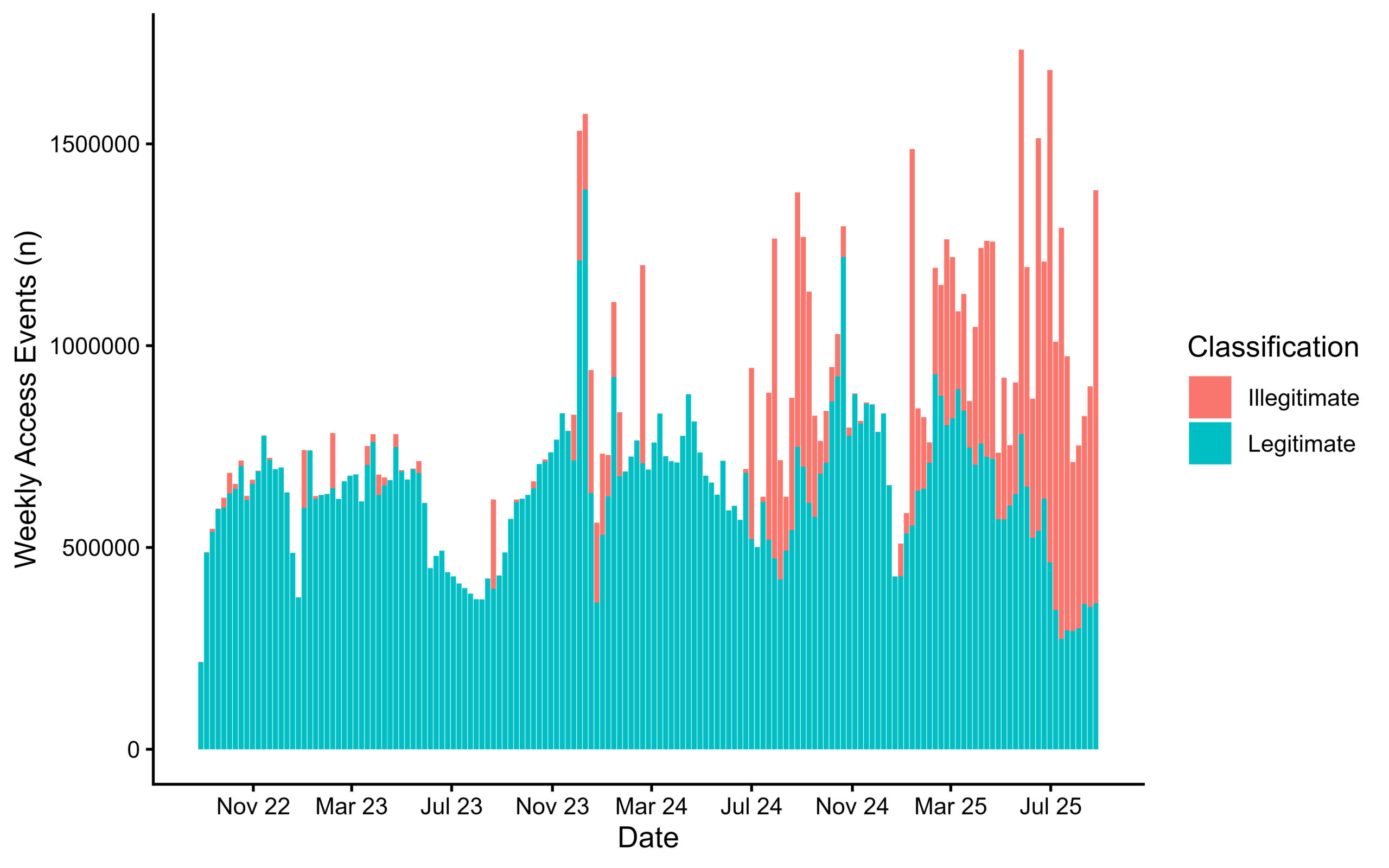
In light of this new reality, we have reinforced the mechanisms aimed at protecting the publications we disseminate by deploying Anubis in fall 2025. This open-source software automatically filters out a large portion of access requests related to unauthorized scraping before they even reach the platform. On top of protecting the platform’s stability, it makes it easier for our teams to detect scraping activity and therefore contributes to more representative usage statistics.
Starting in fall 2025 and after the implementation of these protective measures, our statistical data has started showing a substantial decrease in usage compared to the previous year. Part of this decrease was expected: by better filtering out bots, we were counting fewer access events which should never have been counted in the first place as legitimate usage. However, the magnitude of the decline we observed led us to wonder whether this improved filtering was enough to explain everything, or whether a shift in web users’ browsing habits was also at play. To distinguish between these two phenomena and better understand the trends in our statistics, we conducted an initial analysis of the usage data on Érudit.
Is the Decrease in Access Driven by Bot or Human Behaviour?
This analysis aimed to answer one question: which part of the observed decline in usage since the Anubis deployment is due to better filtering of bots, and which part could reflect a real change in how web users access content? To find an answer, we compared usage of scholarly content on erudit.org over two periods: from October 1, 2024, to June 30, 2025, before the deployment of Anubis, and from October 1, 2025, to June 30, 2026, following the deployment. The full analysis, including its methodology, is provided in the form of a research note deposited on Papyrus, the Université de Montréal’s institutional repository.
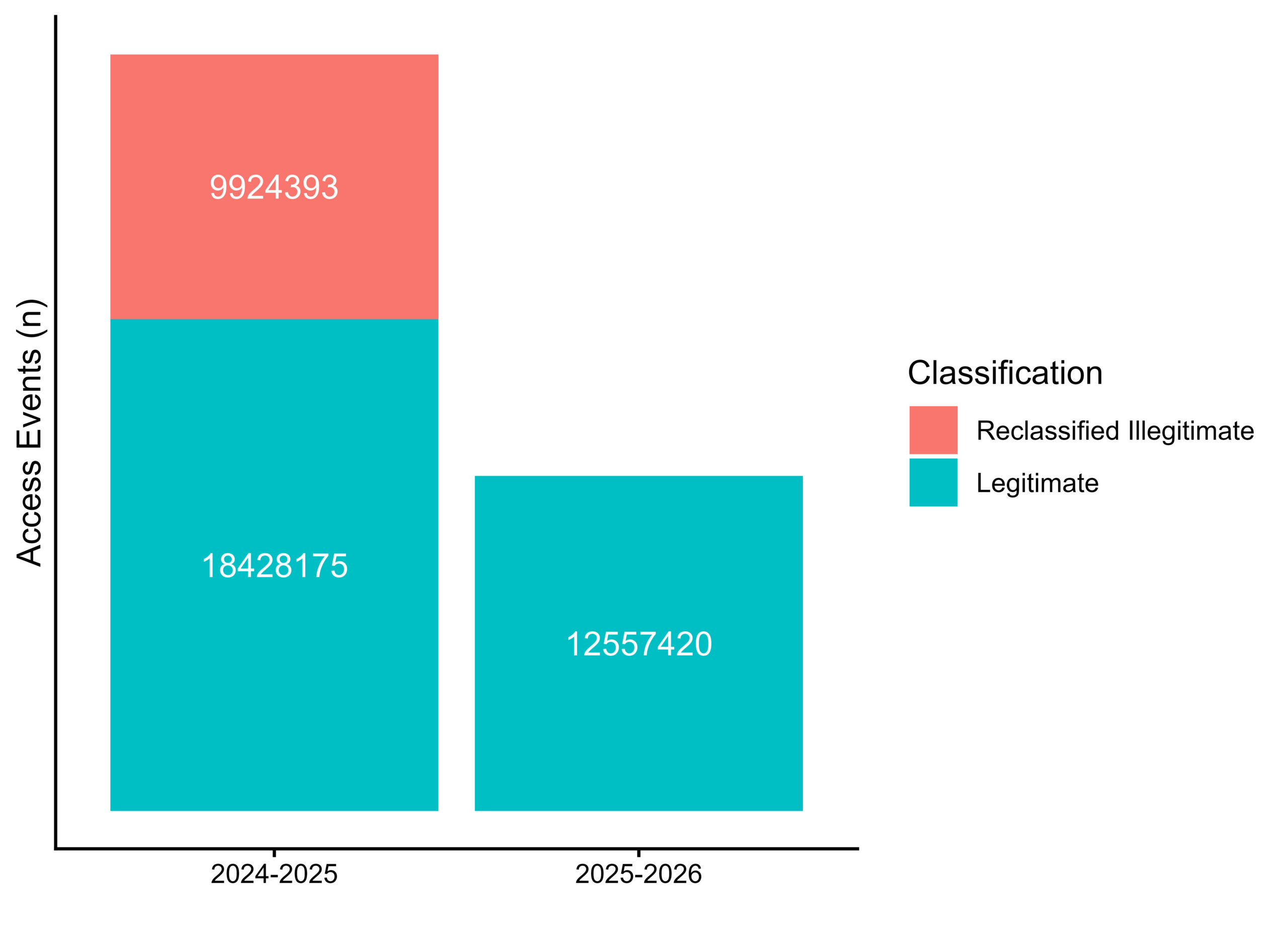
Between 2024 and 2025 and between 2025 and 2026, the number of recorded access events went from 28.4 million to 12.6 million (Table 2). This decline is due more to improved filtering of bots than to a change in user behaviour: approximately 63% of the decline recorded in our statistics is attributable to improved filtering of automated traffic, while the remaining 37% corresponds to a decrease in legitimate usage. In other words, around 35% of access events (9.9 million) that we had initially tagged as legitimate in 2024–2025 were likely illegitimate. Overall, legitimate access events on Érudit have gone down by around 32% in a year, from 18.4 to 12.6 million (Table 2), a decline that matches the one reported by Cairn. This decline does not mean that the knowledge published on Érudit is disseminated less widely, but, rather, it suggests that some of its dissemination may no longer be captured by the metrics we have available.
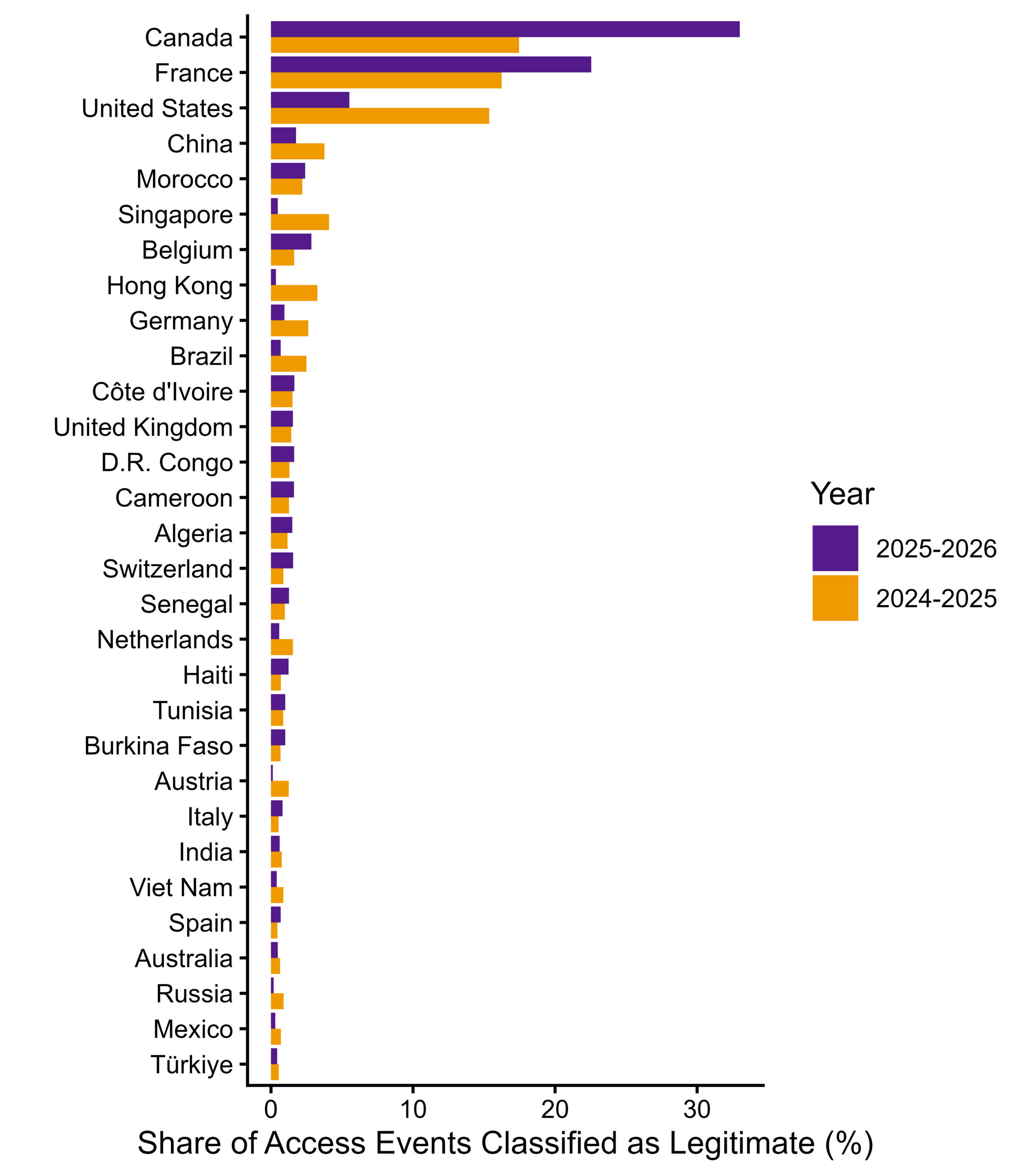
A large portion of illegitimate access events came from a relatively low number of countries, identified through IP addresses. In particular, we noticed a large number of automated illegitimate access events from the United States, as well as from Singapore, Russia, Brazil and China. Consequently, the improved filtering put in place in 2025–2026 changes the geographic metrics for usage on erudit.org (table 3). In 2025–2026, Canada’s share of the global total increased significantly, as did that of France and other countries hosting few or no bots, such as Belgium, Switzerland, and most French-speaking African countries. Inversely, the share from countries with a large number of illegitimate access events has shrunk.
An additional insight appears when we quantify this change based on the web users’ affiliation. The decline in access events by non-subscribed individuals sits at 36%, while it remains limited to only 4% for users associated with an institution that holds a subscription. This gap could be explained by a level of familiarity or engagement, or even a sense of belonging from users with subscription access to Érudit, which would be a trait much less prevalent in non-subscribers, which may include a large non-academic audience.
On Érudit, a user accessing content can be classified based on IP addresses as “subscriber” or “non-subscriber” based on their affiliation with an organization subscribed to the corpus. Users with subscription access can be linked to one of the around 700 organizations with a subscription or a partnership with Érudit, while non-subscribers, or those who do not use their organization’s proxy, cannot be linked in such a way.
An Ongoing Collective Project
Generative AI uses continue to evolve, as do the bots used to scrape scholarly platforms. Since the deployment of Anubis, we have observed new attempts to bypass our protection measures. Our teams are continuing their work to better detect these automated access events, analyze blocked content and continually adapt our methods to protect the stability of our infrastructure and the quality of our data.
In parallel, we are working to evolve the way we are measuring and interpreting the use of scholarly publications. The COUNTER standard is notably exploring the use of new metrics that could help us better distinguish human usage from automated activity. Our teams responsible for research and technological infrastructure are collaborating on these issues, which will be at the core of our work in the next few years.
However, these transformations are much larger than Érudit. Journals, libraries, and other dissemination platforms are also seeing changes in the way knowledge is discovered and used. We want to work even more closely with these communities to share our observations, better understand these new uses, and reflect together on the metrics we will need in the future. It is by pooling our experiences that we will be able to continue highlighting the flow of knowledge and adapt our dissemination methods to this new reality.