
In addition to our platform and the articles it disseminates, Érudit is a digital infrastructure whose wide range of services helps support open scholarly publishing in Canada. But what does that mean, specifically?
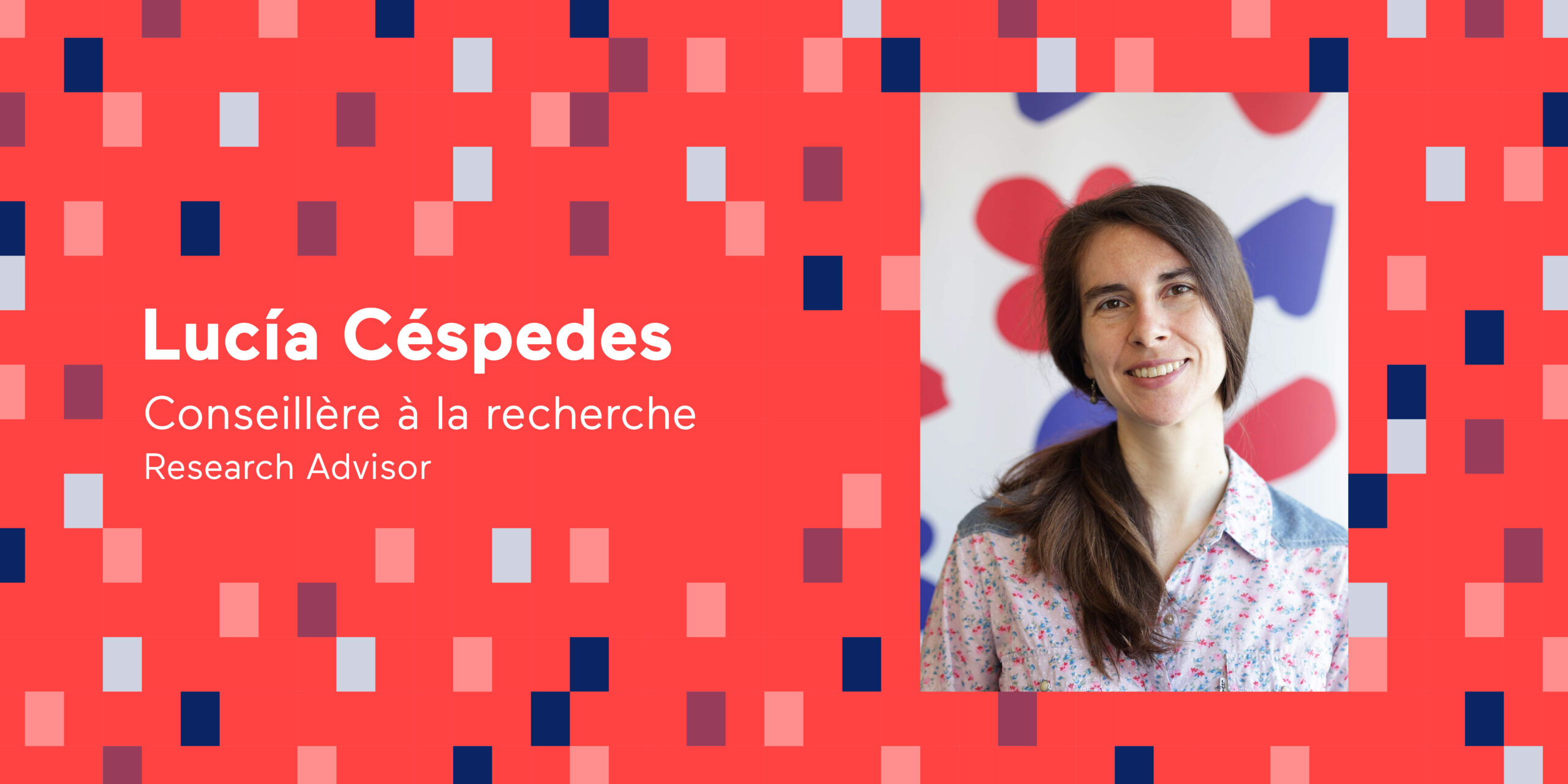
This blog post is the first in a series introducing a handful of members of our team and the work they do on a daily basis. Today, we’re shining the spotlight on Lucía Céspedes, our Research Advisor!
In a few words, how would you describe your role at Érudit?
I am a research advisor specializing in scholarly communication, open access, multilingualism, and sociolinguistic issues in the scientific world. I am particularly interested in the evolution of publishing practices in the context of the growing openness of science in all its aspects.
Could you describe a typical day at Érudit?
I don’t have a typical day, and that’s what I love about my job!
In such a dynamic environment, amid technological and political transitions, it’s important to stay abreast of the latest developments related to the interests of journals, researchers, and infrastructure providers, such as Érudit. All this information feeds into our own projects, which focus on the visibility of science in French, the characterization of Canadian scholarly publications, the challenges of the transition to open access, and the adoption of innovative digital tools for editorial management.
With the research team, we conduct interviews and surveys, consult and analyze data, discuss the applicability of these findings in our context, and look for the best ways to mobilize this knowledge for the benefit of social science and humanities communities, for example, in the form of reports or articles, or at events such as conferences or webinars.
At all times, I try to bring Latin American perspectives to discussions in Canada, in order to bring these two quite different regions closer together, even though they share similar concerns.
I would also like to emphasize that all research is conducted as a team effort. Depending on the subject, we enlist the valuable help and collaboration of our colleagues at Érudit, because applied research can never be done in isolation. In this context, I collaborate on behalf of Érudit with other research teams and entities, such as the UNESCO Chair on Open Science, the Chaire de recherche sur la découvrabilité des contenus scientifiques en français, the Scholarly Communications Lab, and the Réseau Circé.
Which project that you recently contributed to makes you particularly proud?
Together with colleagues from the Réseau Circé, we have just completed a literature review of the literature on peer review practices, focusing on open peer review. We have compiled a corpus of multilingual publications to summarize the key concepts, challenges, and potential of this still-emerging practice, which is gradually being adopted by many journals around the world. We also conducted a survey of 134 editors of scholarly journals in Quebec and Canada. The goal is to guide the implementation of alternative review methods in a manner appropriate to the contexts, disciplines, and resources of each journal. We hope that our final report will be published this spring!
What was your career path before joining Érudit?
When I entered university in Argentina, I studied two subjects in parallel: social communication and English. Over the years, I decided to devote myself to communication research. I obtained my degree in this field and went on to specialize in public communication of science and science journalism. I then turned my attention to the sociology of scholarly communication, i.e., communication channels in the scientific field. But my love for languages has always remained! My doctoral thesis in Latin American social studies focused on Spanish and Portuguese as scientific languages and the linguistic practices of Spanish- and Portuguese-speaking researchers in Argentina and Brazil.
As soon as I joined Érudit, I placed science in French at the center of my research, and I am happy to have added this beautiful language to my own linguistic repertoire.
Before you go, can you recommend any articles or books that are close to your heart?
The article “The Oligopoly of Academic Publishers in the Digital Era” by Vincent Larivière, Stefanie Haustein, and Philippe Mongeon was one of my first encounters with the reality of the global academic publishing ecosystem.
Also, La supremacía del inglés en las ciencias sociales (The Predominance of English in the Social Sciences) by Brazilian sociologist Renato Ortiz is one of those works that I return to again and again, and which always provides me with fascinating new insights!