
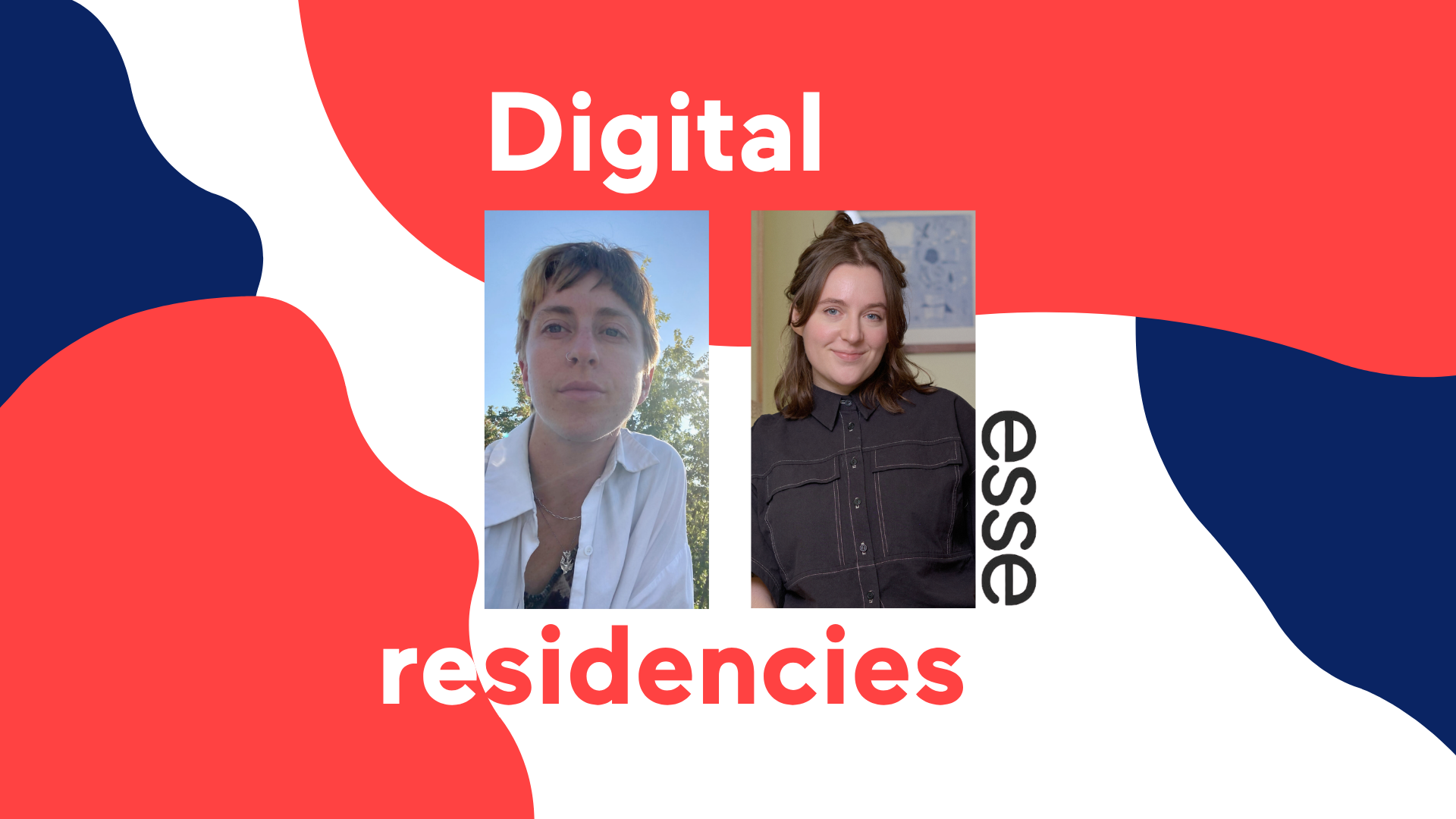
To celebrate World Art Day, we are launching a series of blog posts aimed at introducing Digital Residencies, a project that highlights the enduring relevance of cultural journals.
Since 2024, Esse has been leading the Digital Residencies, an initiative aimed at promoting cultural journals and shedding light on their content in the context of current issues. Each year, selected researchers gain access to Esse’s entire back issues, as well as to all cultural journals available on our platform, erudit.org, to fuel unique and stimulating reflections.
Today, we’re exploring the theme of posthumanism with authors Abby Maxwell (interdisciplinary artist and researcher) and Olivia Vidmar (artist, author, and curator), who have kindly agreed to answer our questions!
Maxwell, Abby (2025). Zombie Reflections: Afterwards, Bodies in Ruin. Esse. https://esse.ca/en/digital-residencies/zombie-reflections-afterwards-bodies-in-ruin/
Vidmar, Olivia (2025). Privileging Non-Human Persistence. Esse. https://esse.ca/en/digital-residencies/privileging-non-human-persistence/
Please note that this interview has been edited for length and clarity
Did your research topic stem from prior interests, or did it emerge during the research process?
A.M. : The topic I chose stemmed from a book I fell in love with the year I did the digital residency, It Lasts Forever and Then It’s Over by Anne de Marcken, which sparked a deep curiosity about this figure of the zombie, the primal concerns it reveals, and how it has changed shape over time.My research process also included watching a bunch of zombie movies, old and new.
O.V. : My research topic for this residency developed slowly over a few years. I had done some research on artists working with abandoned military structures in a way that was more observant and curious, and without necessarily intervening with the processes of decay or new life that had begun to thrive in those structures. This way of yielding to more-than-human ecologies in environments no longer controlled by humans was something that I continue to think about in my research practice.
« This residency gave me the time and space to articulate how this research could inform questions that would guide a more durational period of research and reflection with the Esse and Érudit archives. »
During my residency, my questions also shifted and evolved, and I ended up selecting articles from a wide breadth of artistic practices and mediums.
How did unrestricted access to all the cultural articles available on Érudit influence your research process and your thinking?
A.M. : During my residency, working within the Érudit archive provided a nice container for my research, since the scope began quite broad. And, it animated and deepened the research question, which centered on that of the archive itself.
« […] working within the Érudit archive provided a nice container for my research […] »
O.V. : Working with a range of arts and humanities publications available on Érudit, alongside the Esse archives, allowed me to explore and broaden my research questions across disciplines during my residency. I was able to organize and filter my research using keywords and terms, and feel like I was getting a sense of how the concepts I was interested in were being theorized and considered in different fields and contexts. It was especially valuable for me to have access to these tangential perspectives.
How did the Esse team support you during the residency?
A.M. : The Esse team was very supportive throughout the residency. I was really glad to be connected with past digital resident and member of Esse’s editorial board, Gwynne Fulton, who talked through my topic with me, providing insight and a few helpful references.
O.V. : The Esse team guided me in recommending articles based on my research questions, and they were tremendously helpful and rigorous in their editorial process. This was essential for me in clarifying the links I wanted to highlight between the four texts I selected.
How would you describe the relevance of cultural journals today?
A.B. : Cultural journals can be these wells of unexpected, rich thinking; they are home to slow and proliferating, analytic and generative conversations.
But, I think their relevance can hinge on their accessibility to a readership : journals shouldn’t be kept behind university logins and paid subscriptions. Projects like Érudit are really exciting because they open up avenues for anyone to engage with, and produce their own, scholarly cultural work.
« [cultural journals] are home to slow and proliferating, analytic and generative conversations. »
O.V. : From my perspective as an emerging arts-based researcher, I find value in the interdisciplinarity of cultural journals. To understand where different practices, theories and ideas intersect and diverge is inspiring in that it provides examples of how to build a practice.
In the context of this residency, I was tasked with selecting articles published less recently. It underscored for me how vital cultural journals are as records of how we read and respond to a cultural moment, allowing us to revisit those interpretations and understand how our perspectives evolve over time.
« It underscored for me how vital cultural journals are as records of how we read and respond to a cultural moment […] »
What did you learn from your experience in the Digital Residencies project?
A.M : I really learned the value in honing in on a smaller pool of references when beginning with a broad topic. But the biggest gift the digital residency has given me was the time to explore, make connections, and write. This experience was really valuable to my overall practice as an artist and researcher.
« But the biggest gift the digital residency has given me was the time to explore, make connections, and write. »
O.V. : This was the first feature-length piece I have had the opportunity to publish, and working with the editorial team at Esse to refine my work was a great learning experience that I will take forward in my future endeavours. During my months-long research period working with the Esse and Érudit archives, I also learned about artists, authors and theories that were new to me, and became more familiar with many whom I already admired.
« Having the opportunity to publish a concise text that expresses my research process helps me to build a portfolio that reflects the directions I hope to continue to pursue in my career. »
As a cultural worker often balancing contracts, dedicated time to prioritize research and invite perspectives from the Esse editorial committee has no doubt contributed to my growth as a writer as well.
The authors and their essays
Érudit’s partnership with cultural journals goes way back! In 2010, we launched a retrospective digitization project for the cultural journals that are members of the Société de développement des périodiques culturels québécois (SODEP), and each year we continue to make available several thousand articles focusing on art. Click here to view our entire collection of cultural journals.
References
Zombie Reflections: Afterwards, Bodies in Ruin (2025)
Audissino, E. (2024). The Rezort (2015): Zombies, Refugees and B Protocols. Cinémas, 30(3), 99–121. https://id.erudit.org/iderudit/1111122ar
Dubé, J. & Castañeda-Delgado, M. (2021). Cannibal Actif: The Artist Book as Threshold for Material Encounters. esse arts + opinions, (101), 38–47. https://id.erudit.org/iderudit/94819ac
Kong, C. (2016). Fukushima’s Animal. esse arts + opinions, (87), 40–47. https://id.erudit.org/iderudit/81638ac
Kramer, G. M. (2024). Bruce LaBruce on His Explicit Radical Cinema of Seduction, Otto; or, Up with Dead People, L.A. Zombie, and The Visitor. Monstrum, 7(1), 21–40. https://id.erudit.org/iderudit/1112931ar
Roy, M. (2016). I am in animal. esse arts + opinions, (87), 64–69. https://id.erudit.org/iderudit/81641ac
Privileging Non-Human Persistence (2025)
Boetzkes, A. (2010). Waste and the Sublime Landscape. RACAR : Canadian Art Review, 35(1), 22–31. https://id.erudit.org/iderudit/1066799ar
Caruso, M. (2019). Conversing with Ghosts of the Previously Tamed. Espace, (121), 28–33. https://id.erudit.org/iderudit/89907ac
Williamson, A. (2014). Pre-demolition Art as a Staging of Power-free Relations. esse arts + opinions, (80), 10–19. https://id.erudit.org/iderudit/70968ac
Zhong, E. (2016). From Critical Art to an Art of Reconciliation: Cohabitation with Non-Human Animals. esse arts + opinions, (87), 24–29. https://id.erudit.org/iderudit/81636ac