
“Knowledge is power,” wrote Thomas Hobbes in 1651. At Érudit, we take this motto to heart: it expresses the desire we hold to connect research results with the people who will benefit from them most. It is this mobilization of knowledge that allows science to translate into concrete actions and have a tangible impact on the world.
On top of our platform and the articles it disseminates, Érudit is a digital infrastructure that provides a wide array of services that support open scholarly publishing in Canada. But what does this mean, concretely?
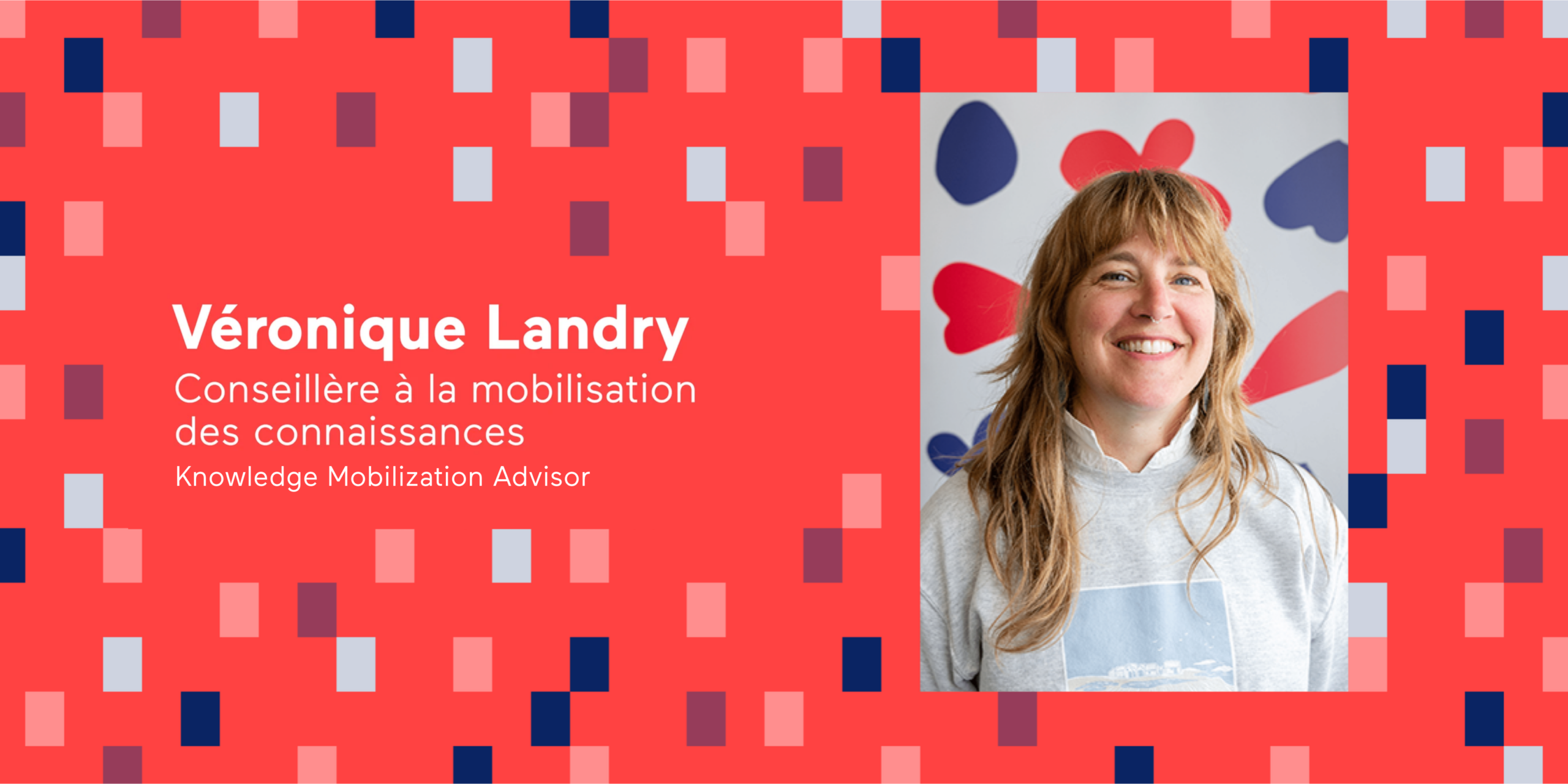
We’re taking this opportunity to continue our “The Team Behind Érudit” project, in which we introduce some of the members of our organization and highlight the work they do every day. This month, meet Véronique Landry, our knowledge mobilization advisor.
What Shape Does Knowledge Mobilization Take at Érudit?
“My role therefore involves creating opportunities for sharing, helping connect knowledge and going out to meet our communities.”
Digital infrastructures like Érudit participate in knowledge creation within the ecosystem by allowing its production, dissemination and appropriation.
Knowledge mobilization takes the form of a set of concrete actions that promote dialogue, the dissemination of knowledge, and its adoption by a wide range of audiences. By creating more opportunities for exchange with communities across the ecosystem which encompasses all of society this approach fosters collaboration on shared challenges. Reaching out to these communities also provides a better understanding of their realities. These communities are broad and diverse: scholarly journals, platform users, decision-makers, researchers, practitioners, and students, among others…
What Does a Typical Day Look Like for You?
“These journals are the pillars of scholarly publishing and dissemination, and that role is very demanding. We want to mobilize knowledge (and skills!) to support them.”
My days are coloured by whatever projects we have ongoing. I have meetings with various teams as we plan knowledge mobilization activities, for example, with the research and innovation team at Érudit, with the Community Engagement Working Group from Coalition publica, or with members of the CIRCÉ Network or various partner organizations. For example, recently, we organized a workshop during the Journée des savoirs ouverts with Chemins de transition and the Collectif des scientifiques pour l’environnement du Québec.
These days, I am working with my colleagues at the Réseau Circé to plan out the creation of a community of practice to support researchers who lead scholarly journals. These journals are the pillars of scholarly publishing and dissemination, and that role is very demanding. We want to mobilize knowledge (and skills!) to support them.
Another example? We are brainstorming a tool that highlights local research to help journalists and scientific communicators in their work.
What Recent Contribution are You Especially Proud of?
During the 2026 Acfas Conference at the Université du Québec à Trois-Rivières, I participated in a panel organized by the Centre interuniversitaire de recherche sur la science et la technologie (CIRST) during which I spoke about the importance of the humanities and social sciences for collective decision-making. Érudit, as a national research infrastructure, contributes to this. I was proud to be on this panel and to speak about Érudit’s contribution in providing scientific advice to policymakers.
What Did You do Before Joining Érudit?
“Drawing on diverse forms of knowledge and fostering dialogue among them at every stage of research are an essential prerequisite for socially relevant research.”
I worked in knowledge mobilization for an organization focussed in health prevention. Before that, there was my academic journey through my master’s and doctoral programs, during which I conducted research and I taught, and also had the opportunity to work with Indigenous communities. These experiences taught me something essential: drawing on diverse forms of knowledge and fostering dialogue among them at every stage of research are an essential prerequisite for socially relevant research.
At the start of my professional life, I worked as a social-vocational integration worker for young adults. All these experiences contributed to the way I approach my role at Érudit; in a very human-centred and involved manner.
Before we Wrap up, Can You Recommend a Few of Your Favorite Journals Hosted on the Érudit Platform?
Revue d’études autochtones, Le Climatoscope, Le Naturaliste canadien… and I have a soft spot in my heart for Biscuit Chinois, a very entertaining journal (which no longer exists).