
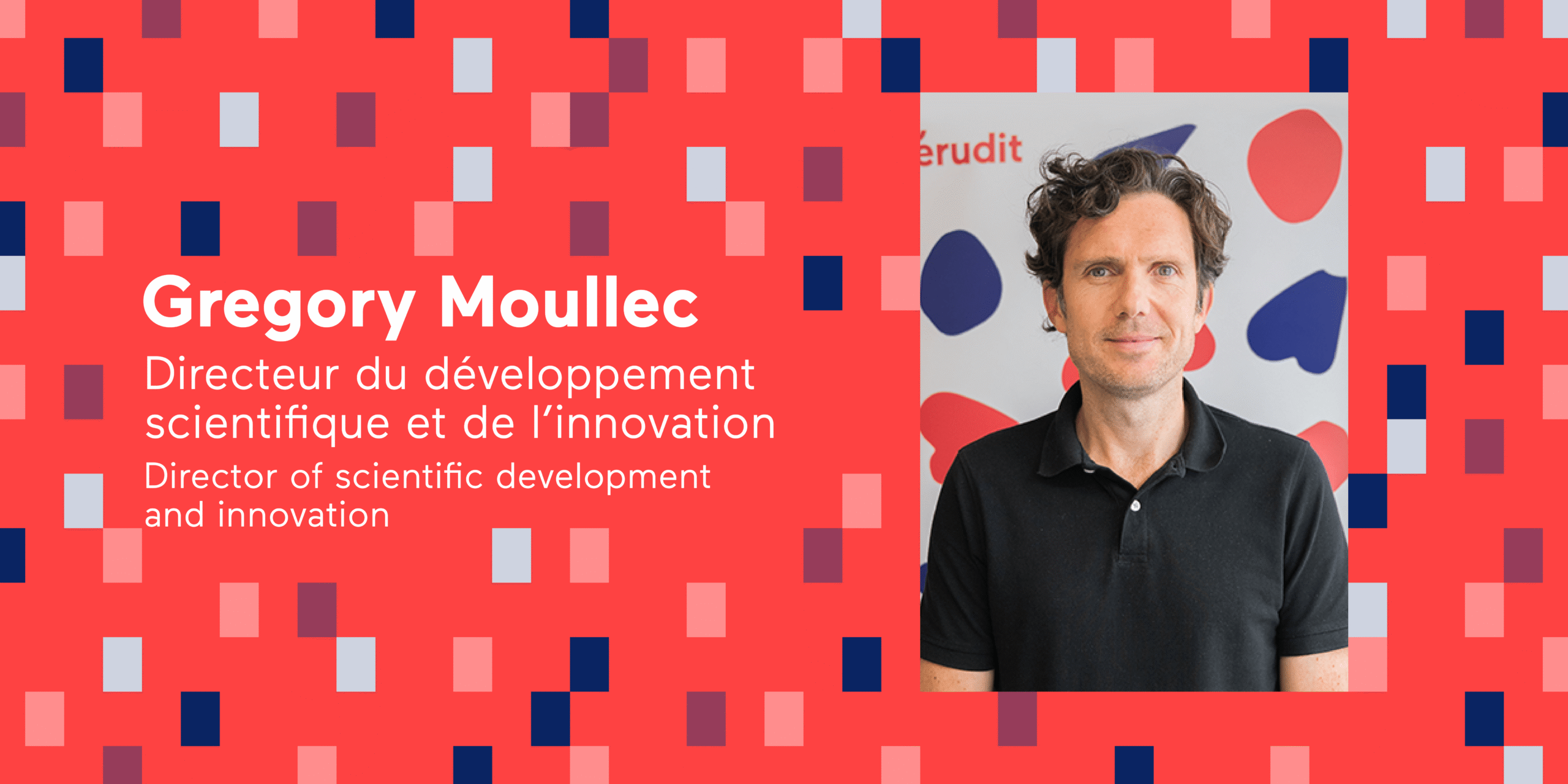
As an organization whose mission is to support the digital dissemination of Canadian knowledge, Érudit must understand and anticipate changes in publishing practices and the scientific landscape. To do so, a scientific perspective is essential, and that’s where our Director of Scientific Development and Innovation comes in.
This month, we’re taking the opportunity of Gregory Moullec’s appointment to launch a new edition of “The Team Behind Érudit,” our series that aims to introduce some of the members of our organization and the work they do every day.
In a few lines, how would you describe your role at Érudit?
I try to help Érudit look a little beyond whatever the current emergency might be.
Innovation plays a role in this, but it is only one tool among others, not an end in itself.
I am in charge of scientific development and innovation. In simple terms, I try to help Érudit look a little beyond whatever the current emergency might be. That means understanding how research and scholarly publishing are evolving, inform the leadership team’s decisions and reflect on the role Érudit wants to play in an ecosystem undergoing a complete transformation. My work then involves translating these ideas into concrete projects with the team and our partners.
Knowledge circulation is what drives me. An article might be available in open access and yet remain practically invisible. It must also be discovered, understood, and relevant to the questions asked by researchers, practitioners, decision-makers, and citizens. In that sense, discoverability shouldn’t be seen only as a technical supplement, but as a condition of knowledge concretely reaching the communities it will benefit most. Innovation plays a role in this, but it is only one tool among others, not an end in itself.
Can you describe a typical day at Érudit?
This question helps to avoid confusing novelty and progress.
No two days are alike, but they always start with a cup of coffee at the Centre d’innovation de l’Université de Montréal. The atmosphere there is warm and offers a pleasant contrast to some of the rather dreary environments found in academic buildings. I also place a lot of importance on informal meetings and discussions. That’s often where the most candid conversations begin. On the same day, I can talk to the research team about what changes artificial intelligence is really making (and what it shouldn’t change), I’ll work with the digital services team on user needs, and then I might have a conversation with a research partner or a member of the university administration.
A major part of my work is also done in calmer situations. Reading, synthesizing and writing to help the leadership team take a step back, clarifying guidance or positioning Érudit among infrastructures, journals, libraries and large commercial platforms. The question that comes back most often is rather simple: who does this project serve, and in what situation? This question helps to avoid confusing novelty and progress.
What contribution that you made recently to a project are you especially proud of?
This approach helps us develop services that meet real needs, rather than just reacting to a simple desire for novelty.
I am particularly proud of the work done on StudIA, our modernization project for the research infrastructure and the discoverability services at Érudit. It notably allows us to improve research, multilingualism and corpus exploration, while also carefully evaluating what some artificial intelligence tools can really bring… and what we shouldn’t rely on those tools for.
The temptation is to start with the technology, since it is evolving quickly and making a lot of noise. We have decided to start with the people. We ask ourselves how they find an article, how they evaluate if it is relevant, and what they want to do with it after. This approach helps us develop services that meet real needs, rather than just reacting to a simple desire for novelty. This project is especially important to me, as it reminds us that behind the platforms, the metadata and the protocols, there is a very human question: who will find, appropriate and use this knowledge?
What was your career path before joining Érudit?
I did not take the most direct path to working for a scholarly publishing infrastructure. I first studied psychology at Montpellier in France, then behavioural medicine, clinical epidemiology and biostatistics in Montréal, Vancouver and Paris. I then worked for more than ten years in public health, mostly at the Université de Montréal and the Centre de recherche at the CIUSSS du Nord-de-l’Île-de-Montréal.
I conducted research on mental health, chronic diseases and social and territorial health inequalities, while leading teams and projects that brought together scientists, clinicians, municipalities and community organizations. Each and every time, I noticed we could produce solid results, often on questions directly related to people’s lives, without being able to have them systematically reach communities and decision-makers who could use them. I became more and more interested in what happens to knowledge after it’s published.
I also co-founded Kwerty, an entrepreneurship experience born of that same concern. My goal was to help organizations find, evaluate and use reliable knowledge without losing sight of their origins and limits. That is the thread that led me to Érudit.
Before we finish, can you recommend a few articles hosted on the Érudit platform?
- La découvrabilité et l’écosystème du livre : vers une nouvelle conceptualisation du système-livre, by Joanie Grenier. I like that this article presents discoverability as an issue that is much wider than metadata or visibility. It structures the very conditions in which works and ideas circulate.
- « Je n’en peux plus de me battre contre le système » : perspective phénoménologique critique de l’expérience des soignants travaillant auprès des personnes migrantes à statut précaire à Montréal, by Émilie Pigeon-Gagné and Élise Bourgeois-Guérin. This research illustrates the capacity that works anchored in the needs of a community have in highlighting the very concrete effects of social structures.
- Les affordances scientifiques et sociales du photovoix en contexte de santé mentale, by Julie Karmann, Kinda Wassef, Maxi Gaudette and Olivier Ferlatte. This article clearly demonstrates that a research method can simultaneously generate rigorous knowledge, empower participants, and create a genuine space for dialogue. On a more personal note, its authors are close colleagues, including a friend of mine.